Control cables
Control cables for energy chains
– Cores wound in bundles for long service life
– Six different outer jacket materials
– Large selection of core cross section combinations
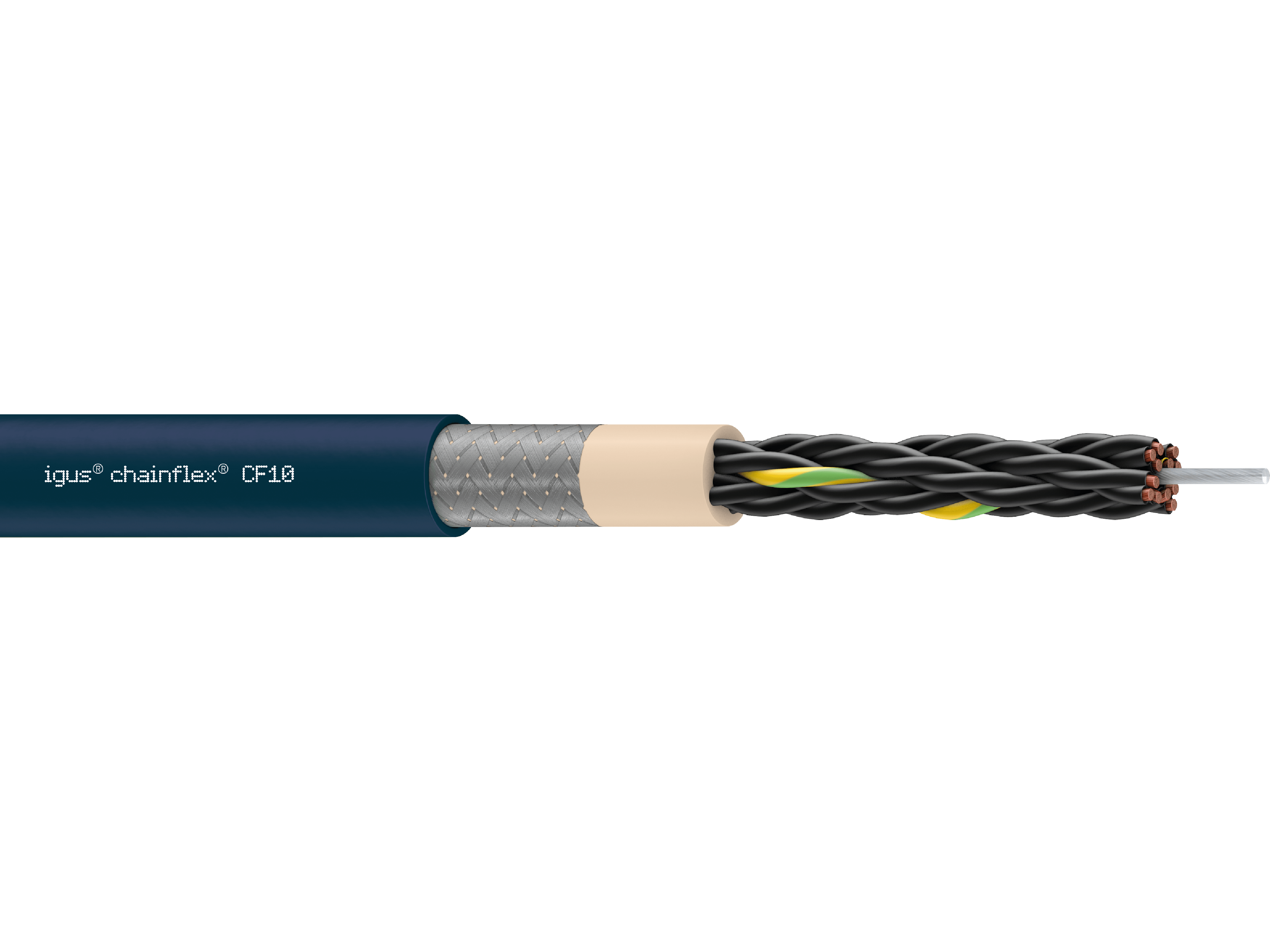
With chainflex control cables we can offer you a wide selection for different areas of application. You can buy unshielded or shielded control cable, and choose between different numbers of cores, outer diameters and outer jacket materials such as PVC, PUR and TPE.
Chainflex are highly flexible cables, and our control cables can achieve a bend factor of up to 3xd – and therefore suitable for highly demanding applications.

Control cables – Product overview >
7 basic rules for a good cable
1.
STRAIN-RELIEVING CENTER
2.
STRANDS OPTIMISED FOR MOVEMENT
3.
CORE INSULATION
4.
STRANDING
5.
INNER JACKET
6.
SHIELDING
7.
OUTER JACKET
Frequently Asked Questions about Control Cables
Find answers to common questions about control cables for energy chains, automation, and moving industrial applications. Learn more about cable design, shielding, jacket materials, bend radius, and long service life in demanding dynamic environments.
Control cables are electrical cables used to transmit control signals between machines, sensors, motors, drives, control panels, and automation systems. In moving applications, they must be designed to handle repeated bending, mechanical stress, and long-term industrial use.
Control cables for energy chains are highly flexible cables designed for continuous movement inside cable carriers or drag chains. They are built to withstand repeated bending cycles while maintaining reliable signal transmission in automation, robotics, machine tools, and production equipment.
Standard control cables are often intended for fixed or limited-flex installations. chainflex® control cables are designed specifically for moving applications, with movement-optimised strands, special stranding, suitable insulation, inner jackets, shielding options, and durable outer jacket materials. Asiflex describes chainflex® control cables as highly flexible and suitable for demanding applications.
Shielded control cables should be used when signal integrity is important or when the cable is installed near motors, drives, frequency converters, or other sources of electromagnetic interference. Shielding helps reduce noise, crosstalk, and unwanted signal disruption in industrial automation systems. Twisted-pair and shielded cable designs are commonly used to improve electromagnetic compatibility.
Unshielded control cables are suitable for applications where electromagnetic interference is low and the control signals are not especially sensitive. They can be a cost-effective choice for simpler machine wiring, control panels, and energy chain applications where shielding is not required.
Bend radius is critical because excessive bending can damage conductors, insulation, shielding, or the outer jacket. For moving applications, choosing a cable with the correct bend factor helps extend service life and reduce downtime. Asiflex notes that their chainflex® control cables can achieve a bend factor of up to 3xd for highly demanding applications.
Control cables are commonly available with outer jacket materials such as PVC, PUR, and TPE. PVC is often used for general industrial applications, while PUR and TPE are typically selected for more demanding environments involving abrasion, oil, chemicals, continuous motion, or wider temperature ranges. Asiflex states that chainflex® control cables are available with several outer jacket materials, including PVC, PUR and TPE.
A control cable for continuous movement should have fine-stranded conductors, movement-optimised conductor design, suitable core insulation, correct stranding, possible inner jacket support, reliable shielding, and an outer jacket matched to the environment. Asiflex highlights these as core design principles in its “7 basic rules for a good cable”.
Flexible control cables are commonly used in energy chains, automation systems, robotics, machine tools, packaging machines, production lines, handling equipment, cranes, and other machinery where cables are exposed to repeated movement or vibration.
Choosing the right control cable depends on movement type, bend radius, number of cores, conductor cross-section, shielding requirements, outer diameter, jacket material, temperature range, chemical exposure, oil resistance, and installation environment. For dynamic applications, it is important to select a cable specifically designed for energy chains or continuous flexing.
Got any questions? Contact our product manager!
Benjamin Kaya Brandshaug
Product Manager –
Chainflex® & Readycable®
